
Garden tool MOQ means the minimum order quantity a supplier accepts for an agreed product specification. For wholesale buyers, the important question is not only “What is your MOQ?” but also “Which model, color, branding and packaging does that quantity cover?”
There is no single minimum quantity that applies to every garden tool order. An existing model in standard packaging may have different requirements from a custom handle color or a printed retail box. Confirm the scope before comparing quotations.
Why one order can have several minimum quantities
A purchase order may combine several production activities. The tool, logo application and printed packaging may each involve a different batch size or setup. Ask the supplier to identify the requirement for each part rather than giving only an overall order total.
- Model MOQ: the minimum quantity for a particular tool and construction.
- Color MOQ: the requirement for each custom color, where applicable.
- Branding MOQ: the batch requirement for the chosen logo process.
- Packaging MOQ: the requirement for each printed card, sleeve or box design.
These are questions to clarify, not universal rules. A supplier may combine some requirements or quote different arrangements for stock and made-to-order products.
Separate total quantity from quantity per SKU
A request for 2,400 tools can mean one model or a collection of several models and colors. The production implications are different. List the units for each SKU, and define what makes each SKU distinct.
For example, four models with two colors each create eight variants. An even split of 2,400 units would be 300 units per variant. This arithmetic does not establish that 300 units is an acceptable MOQ; it shows the quantity the supplier needs to assess.
Use the garden tool RFQ checklist to present the model list, quantities and open questions in one inquiry.
Understand how customization changes the discussion
Before requesting a lower minimum, identify which features are essential to the launch. An existing tool with a logo is a different development project from a new handle, changed dimensions or custom tooling. Ask which requested changes drive the minimum and whether a standard option is available.
Our OEM vs ODM garden tools guide explains how to organize these specifications. Keep any proposed alternative in writing so a lower quantity does not quietly change the product you expected.
Review retail packaging separately
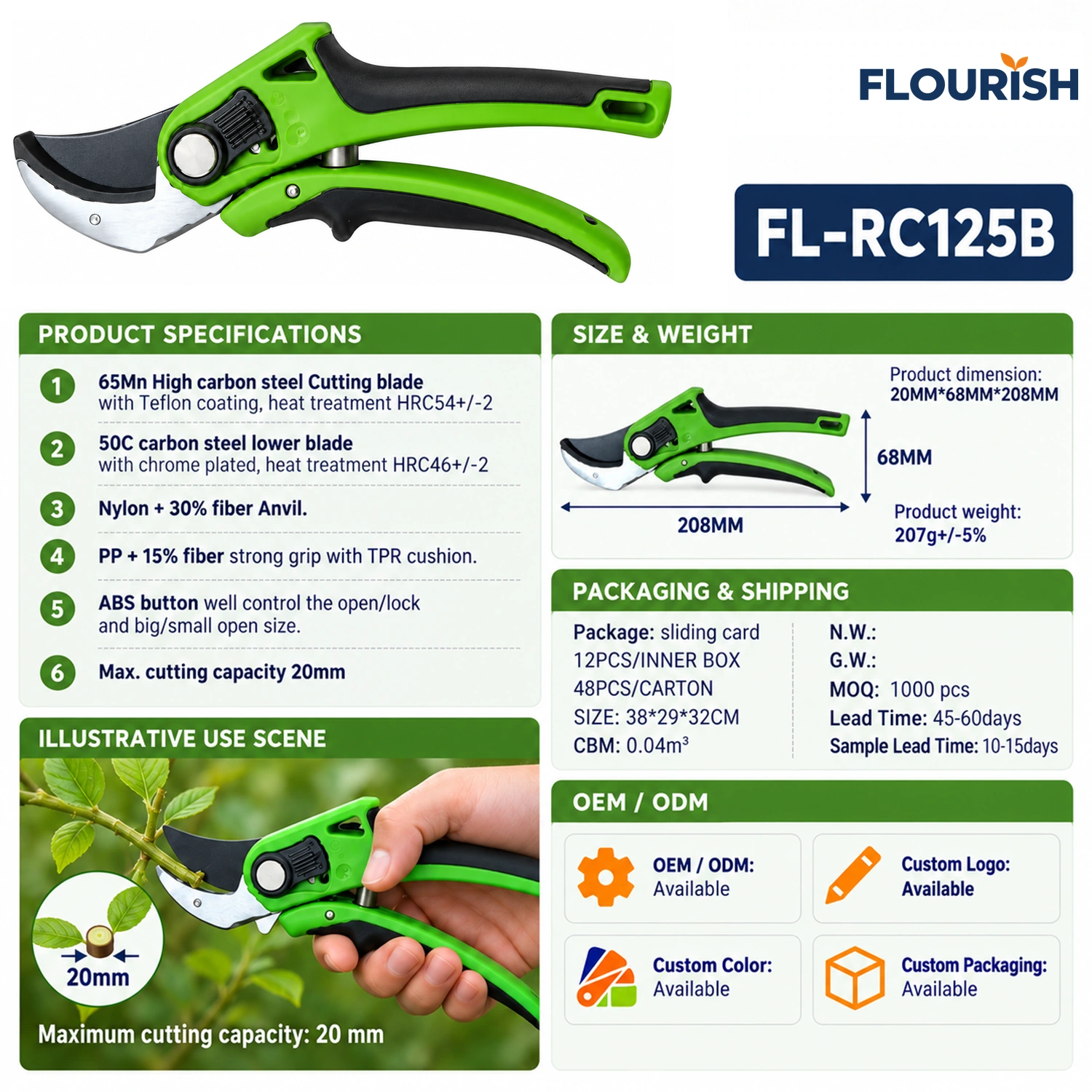
A custom package can introduce its own minimum even when the tool quantity is acceptable. Clarify whether the quote includes standard packaging, a printed hanging card or an individual box. Ask whether different models can share artwork or whether every version requires a separate print run.
Do not assume unused packaging will be stored for a later order. If that is proposed, agree on ownership, payment, storage period and what happens if the artwork changes. Use the garden tool packaging checklist to capture the agreed pack format and quantities.
Ways to discuss a smaller first order
Ask for options rather than simply requesting a discount on the minimum. Depending on availability and the production plan, a supplier may be able to assess:
- An existing model with standard materials and finish.
- Fewer color or packaging variants.
- A smaller selection of models for the first launch.
- Standard packaging with an agreed label or branding treatment.
- A separately quoted setup charge for a smaller batch.
None of these options is guaranteed. Compare the revised specification, unit price and one-time charges together. A lower MOQ may carry a higher unit cost, while a larger order increases inventory exposure.
Confirm the sample before increasing the order
A larger quantity should follow a clear product decision. Review the sample, record changes and agree on the production reference before increasing the commitment. See our sample-to-production approval guide for the handover details.
Keep a forecast separate from a confirmed purchase quantity. If future volume is uncertain, describe it as an estimate and ask for the current order to be quoted on its own terms.
Questions to include in your MOQ inquiry
- Does the minimum apply per model, color, logo or packaging design?
- Can models be combined, and what minimum applies to each?
- What changes if we use standard packaging or fewer variants?
- Are setup, tooling and printing charges included?
- What sample approvals are needed before production?
- How long is the quotation valid, and what starts the lead time?
Frequently asked questions
Does MOQ mean the same as carton quantity?
No. MOQ is the minimum order requirement; carton quantity describes how units are packed. Confirm both and ask whether orders must be in full-carton multiples.
Can different garden tools share one MOQ?
Sometimes a mixed order can be assessed, but do not assume that a total quantity replaces model-level requirements. Send the proposed quantity for each model and request written confirmation.
Does a sample order establish the production MOQ?
No. Sample arrangements and bulk production requirements can differ. Ask for both during the quotation discussion.
Plan a clearer first order
For a Flourish Garden Tools inquiry, provide your model list, quantities per variant, branding and packaging preferences. Mark any flexible requirements so the discussion can focus on a practical first order and a clearly defined specification.